
How Semantic Networks Can Help Universities Choose A Winning Brand Platform

Higher education is facing a brand crisis hiding in plain sight. As tuition costs rise, program offerings multiply, and campus experiences begin to look increasingly similar, universities are competing harder than ever for the same prospective students while using the same messaging to reach them. For most universities, highlighting academic excellence is not enough to stand out from other institutions.
In a commoditizing market, positioning against everything owns nothing. The institutions that break through aren't the ones with the largest media budgets or the most expansive list of offerings, but ones that have put a singular, values-driven stake in the ground and built everything, from recruitment to alumni engagement, to consistently deliver on it. That kind of clarity doesn't come from committee consensus or executive intuition. It comes from understanding, with real precision, what prospective students, parents, and alumni are actually looking for and developing a brand direction that most authentically connects to that. This is where universities have the most to learn from how sophisticated consumer brands approach positioning: not as a creative exercise, but as a strategic and insights-driven decision.
Semantic network analysis gives university brand leaders that foundation by diving deeper into the meanings associated with brand concepts. Rather than asking respondents to rate concepts on predetermined scales, semantic networks capture the words that come spontaneously to mind when someone sees a concept and then map how those words connect to each other. Importantly, this analysis shows how meaning is structured: which associations are central and influential, which cluster naturally together, and how closely a concept's meaning aligns with what prospective students view as their ideal university experience.
To make this concrete, we'll walk through a real example using three brand concepts developed for a large public research university (referred to here as Lakewood University for anonymity). The concepts were tested in a 20-minute online survey with approximately 800 prospective high school students and parents. Semantic networks were built from word association responses. The findings not only identified a clear winning direction, but they also revealed why it won and how to build on it.
Three Strategic Concepts, One Decision
Before testing with respondents, three strategic brand directions were translated into consumer-facing "strategy boards" — visual and verbal concept statements designed to communicate each positioning idea in a tangible, testable form. This is a critical step because abstract strategic language needs to be rendered into something respondents can actually react to.
Each board was developed after conducting extensive focus group testing with prospective students and combines a headline, supporting imagery, and body copy evoking the spirit of the positioning:
Concept 1 — "Empowers me to thrive in the real world": An individualistic, outcome-focused positioning centered on personal success and real-world readiness. Tagline: "Always supporting me. Always uplifting me"

Concept 2 — "Helps you discover your path to success": A journey-oriented positioning centered on exploration, mentorship, and personal discovery. Tagline: "Unleashing your passions and potential"

Concept 3 — "Inspires us to make a positive impact": A collectivist, purpose-driven positioning centered on community contribution and shared societal impact. Tagline: "Positivity is contagious. Pass it on."
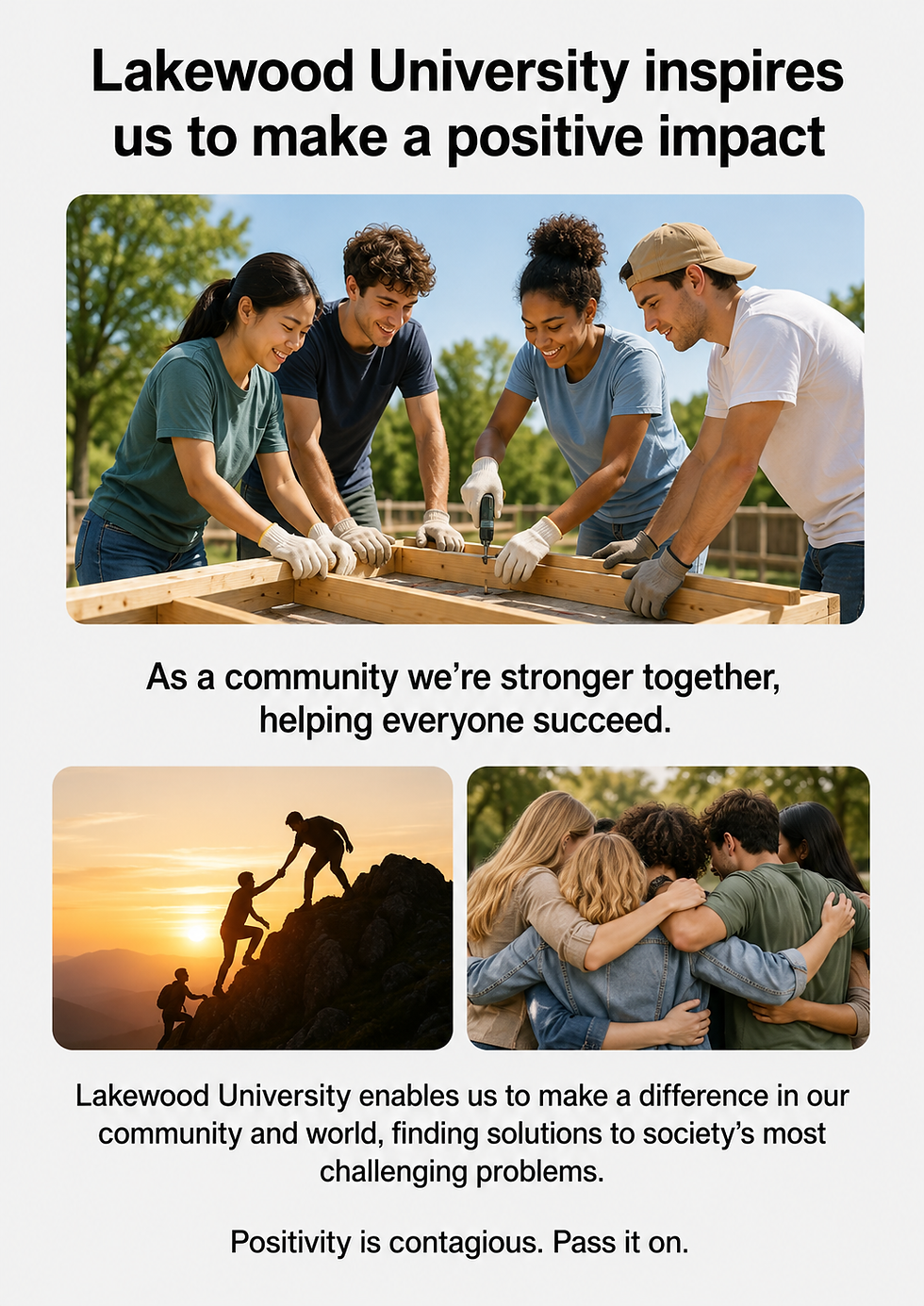
Three credible directions, each internally coherent. Any could be defended in a strategic presentation. The question was which one would actually land most closely to what prospective students already associate with their ideal university experience.
The Methodology: Semantic Networks and Impact Scores
The survey included two open-ended questions that formed the foundation for semantic network analysis:
• "Imagine you just enrolled in your dream college or university. What are the first three words or phrases that come to mind when you think of your ideal college experience?" — establishing a baseline of what respondents genuinely want
• "What are the first three words or phrases that come to mind when you think of this concept?" — asked separately for each brand concept after respondents viewed the strategy board
These survey questions don't ask respondents to rate anything or choose from a list. They capture automatic associations; words that surface before deliberate evaluation begins. This distinction matters because brand perception operates largely at this pre-conscious level. When a prospective student encounters a university's name or tagline, what they feel in those first moments reflects their associative network, not a considered opinion.
From these responses, we construct semantic networks where:
• Each unique word or phrase becomes a node in the network
• A tie is formed between two nodes when the words appear together in the same response
• Concepts that co-occur frequently develop stronger ties
• Node size reflects the semantic impact score — a measure of how central and influential each concept is across the full network
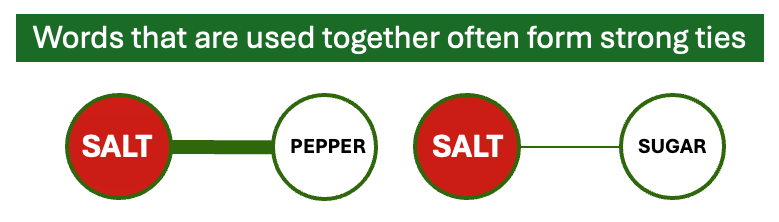
The impact score works similarly to how transportation hubs function: some nodes are highly connected to many others (think major international airports) while others are peripheral with few connections. A word that is both frequently mentioned and well-connected to other important concepts earns a high impact score, indicating it's a semantic hub that anchors meaning in the network.

What the Ideal University Network Revealed
"Growth" earned the highest impact score when respondents described their ideal college experience. This finding established the benchmark against which every brand concept would be measured.
Before evaluating the brand concepts, we needed to get a fuller picture on what prospectives were actually looking for in a university. The ideal college experience network, built from spontaneous word associations across all respondents, organized into four distinct thematic clusters:
The Four Clusters of the Ideal Experience
Personal Growth (the dominant cluster): Growth held the highest impact score, with opportunities, personal, and academic as the strongest supporting concepts. The cluster also contained words like inspiring, intellectual, exploration, friendships, and lifelong — pointing toward a conception of university as a space for continuous, meaningful development rather than credential acquisition alone.
Campus Life: Campus life reflects the social and experiential dimensions of the university environment. This shows that students aren't just thinking about learning — they're thinking about living.
Academic Excellence: Excellence, academic, success, and freedom formed a coherent cluster around the pursuit of rigorous scholarship and the independence that comes with it.
Community Learning: Education, learning, community, and diverse clustered around the collaborative dimensions of learning. This is knowledge gained alongside and through other people.

The headline finding was unambiguous: Personal Growth was the most impactful concept in the ideal university semantic space. When the analysis compared brand concepts against this baseline, the central question became: which concept's meaning structure most closely overlaps with this network? Which one speaks the language an ideal university already speaks in students' minds?
That alignment was measured through an overlap score, which is the percentage of high-impact words in a concept's network that also appear as high-impact words in the ideal experience network:
• Concept 1 (Thrive): 25% overlap
• Concept 2 (Discover): 40% overlap
• Concept 3 (Impact): 20% overlap
Concept 2 — "Helps you discover your path to success" — matched the ideal university semantic space at twice the rate of Concept 3 and significantly outperformed Concept 1. But the network analysis reveals further nuance into why Concept 2 won.
Reading Each Concept's Semantic Network
Overlap scores tell you which concept won. Network structure tells you why and which concept elements could be repurposed.
Concept 1 — Thrive: Emotionally Resonant But Narrowly Focused
The Concept 1 network organized into three clusters. A Growth & Passion cluster contained words like passion, development, and growth. An Uplifting & Success cluster contained words like uplifting, supportive, unique, innovation, and success. A Real World Learning cluster contained learning, real, experience, and world.
Top semantic impact scores: growth (highest), followed closely by success, support, passion, and uplifting.

Strategic implication: Concept 1 owns passionate, uplifting emotional territory. Its weakness is breadth — it doesn't speak to academic ambition or the community dimensions that matter to prospective students.
Concept 2 — Discover: The Strongest Alignment
The Concept 2 network organized into three clusters. A Growth & Learning cluster contained words like growth, learning, inspiration, opportunities, discovery, and exploration. A Passion & Potential cluster contained words like passion, potential, and fun. A Successful Path cluster contained success and path.
Top semantic impact scores: growth (highest), followed by success, inspiration, opportunities, and learning.

Strategic implication: Concept 2 is the strongest foundation for brand development because it activated the widest range of concepts that also appear in what respondents say they want from an ideal university, as shown by the 40% overlap score.
Concept 3 — Impact: Coherent But Misaligned
The Concept 3 network organized into three clusters. A Community Success cluster contained words like community, teamwork, and helping. A United Team cluster contained words like team, friendship, and unity. A Positive Impact cluster contained impact, support, and positive.
Top semantic impact scores: community (highest), followed by positive, teamwork, success, and team.
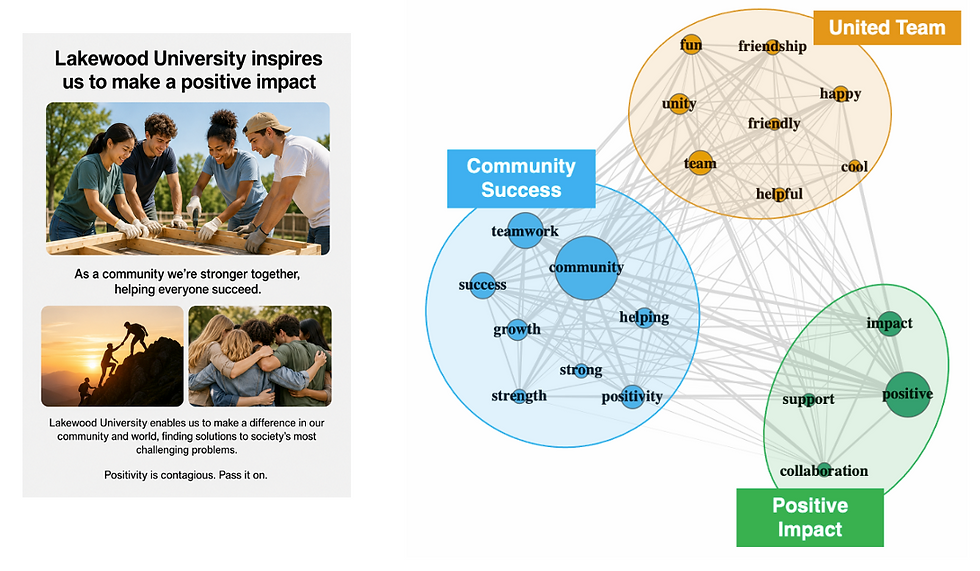
Strategic implication: Concept 3 owns distinct and coherent territory, but that territory is less aligned with what this audience is seeking from a university. It may find stronger resonance with alumni and donor audiences, for whom community and shared impact are more central motivations. The 20% overlap reflects genuine divergence between concept values and audience priorities, not a failure of communication.
Beyond Concept Selection: Using Semantic Networks to Test Brand Imagery
Identifying the winning brand concept is just the beginning. Once a platform direction is chosen, every executional decision — photography style, visual color language, representation of people — needs to express and reinforce that platform rather than contradict it. This is where semantic network analysis extends into visual brand development, and where many organizations leave significant strategic value on the table.
Across all three concepts in this study, respondents consistently selected images as among their most interesting elements. This is consistent with what we know about how visual content is processed: images are perceived faster, retained longer, and carry emotional associations that text rarely achieves. Getting imagery right is not just an aesthetic decision but also a strategic one.
Semantic network analysis can be applied directly to imagery testing using the same methodology. It works as follows:
• Respondents are shown a set of candidate images being considered for the brand platform — photography styles, representative people, environmental contexts, metaphorical visuals, illustration approaches
• For each image, respondents answer: "What are the first three words or phrases that come to mind when you see this image?"
• Semantic networks are constructed from those word associations, and impact scores identify the central meaning each image communicates
• Those meanings are then compared against the winning brand concept's semantic network — specifically against the high-impact concepts that made Concept 2 the strongest performer


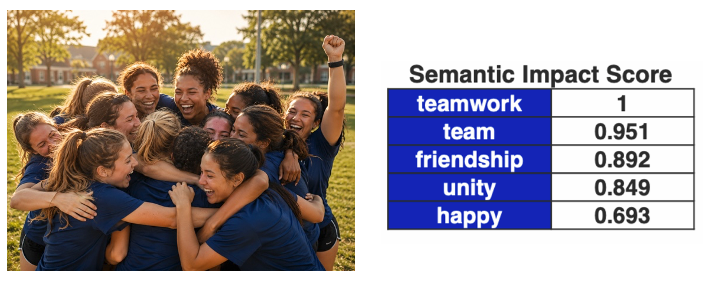
This analysis answers an important question: does this image activate the meaning we need it to activate? A photograph of two students engaged in conversation in a campus library might be intended to communicate intellectual community and collaborative learning. But if its semantic network surfaces high-impact scores for stress, pressure, or obligation, it's communicating something different from what the platform requires — regardless of how well-composed the image is.
For the winning Concept 2 platform, the target semantic territory includes: growth, learning, inspiration, opportunities, exploration, journey, and passion. Images whose own semantic networks score highly on these dimensions are the images that will do the most work for the brand. Images that activate different territory risk creating a gap between what the platform promises and what the execution delivers.
Imagery is not decoration for a brand platform — it is a primary meaning-making tool. Semantic network analysis gives you a rigorous, quantitative method for ensuring your visual choices are doing the strategic work you need them to do.
This principle extends to every visual decision under consideration: a winding path photograph versus a sunrise image, diverse group shots versus individual portraits, architectural campus imagery versus people in natural settings. Each visual carries its own semantic network. The brand must ensure those networks reinforce the same central meaning so that every element pulls in the same direction.
What This Means for University Brand Strategy
The Lakewood University study illustrates a more in-depth approach to brand concept testing. Traditional metrics such as preference ratings and ranking scales only show you the surface of what audiences think. Semantic network analysis dives into the underlying meanings associated with a brand concept and whether these associations matches what prospective students think of as their ideal university.
These are different questions, and they don't always produce the same answer. A concept can be preferred without having high semantic alignment with the audience's deeper aspirations. A concept can be distinctive without connecting to the right associations. Conversely, a concept with deep semantic alignment might not be the most immediately exciting, but it's the one that will wear well over time because it speaks the same language its audience already uses.
Different audiences also have different semantic baselines. Alumni, current students, graduate students, and prospective undergraduates may each hold distinct ideal experience networks. Segment-specific analysis reveals which concept resonates most strongly with which audience, enabling targeted brand expression without abandoning platform coherence.
Conclusion: Giving Brand Decisions a Quantitative Foundation
University brand strategy involves too much complexity and long-term consequence to rely on committee intuition alone. The concepts are carefully developed, the creative work is credible, and everyone in the room has an opinion. What's usually missing is an objective measure of what those concepts actually communicate to the people they're designed to reach.
Semantic network analysis provides that measure without losing meaningful nuance often overlooked by traditional metrics (e.g., preference ratings). It reveals which associations are central, how concepts cluster, and what territory a brand platform activates. Importantly, our approach enables direct comparison between what a concept communicates and what an audience is genuinely seeking, producing a quantitative alignment score that grounds one of higher education's most consequential marketing decisions in evidence.
The question universities should be asking isn't just "which concept do prospective students prefer?" It's "which concept best aligns with the prospective student’s ideal university experience?" Semantic networks answer the second question, which matters for building a brand that endures.
─────────────────────────────────────────
About This Methodology
This case study draws on semantic network methodology described in a recent white paper published by HDI and Elevancy: Beyond Word Clouds: Using Semantic Networks to Transform Open-Ended Survey Responses into Strategic Intelligence. The same approach can be applied to brand concept testing, imagery testing, messaging strategy, competitive positioning, and social listening across industries and institutional contexts.
Contact Michael@hauptdatainsights.com or Sheri@elevancyllc.com to learn how semantic network analysis can provide a quantitative foundation for your brand strategy decisions.


Comments